The arithmetic
One Page, One Action — Why Campaign Pages Strip Everything Out
The case for a single call to action is not a conversion statistic. It is that a page with one ask is measurable and a page with six is not, and measurement is the only thing you are actually buying.
Written 20 Aug 2026Revised 19 Sept 20266 min
Every landing page guide tells you to remove the navigation and use one call to action. Most of them justify it with a statistic. This one will not, because the statistics in this area are unreliable and the real argument is better.
The case for a single action is not that it converts better on average. It is that a page with one ask produces a number you can act on, and a page with six produces a pile of numbers you cannot. Measurement is the entire reason to pay for a platform from the best landing page builders ranking rather than publishing on the website you already have, so anything that degrades measurement is expensive whatever it does to your conversion rate.
Why the folklore is unreliable
You have read the claims, and they all have the same shape: a specific, memorable, three-figure percentage attached to one change. Removing the navigation lifted conversions by some striking amount. A single call to action beat multiple by a large multiple. Shortening a form produced a headline number.
Some of these describe real tests on real pages. The problem is not fabrication; it is transfer. A result from one company’s offer, with one company’s traffic source, in one market, during one fortnight, is a fact about that campaign. It becomes folklore when it is restated as a property of landing pages in general, and by the time it reaches a listicle it has usually lost its sample size, its confidence interval and its context.
Two pages that differ only in navigation are still two pages selling different things to different people. There is no reason to expect the difference measured on one to appear on the other, and plenty of published attempts to replicate famous results have failed quietly.
So: no lift figures on this site, and a healthy suspicion of anyone who leads with one.
The measurement argument
Here is what survives when you take the statistics away.
A campaign page exists to produce a countable outcome from traffic you paid for. If the page has one action, every visitor either did it or did not, and the resulting rate means something. You can compare it to last month. You can compare two versions of the page and know what the difference is attributable to.
Add a second action — a newsletter sign-up beside the trial button — and the number splits. Now you have two rates that move against each other, and an improvement in one may be a cannibalisation of the other rather than a gain. Add navigation and you have added a dozen exits, each of which removes a visitor from the denominator in a way you cannot see.
None of this means the second action is worthless. It means you have stopped being able to tell. And since you are paying between $69 and $159 a month for the ability to tell, giving it up casually is a strange trade.
Six asks, one ask

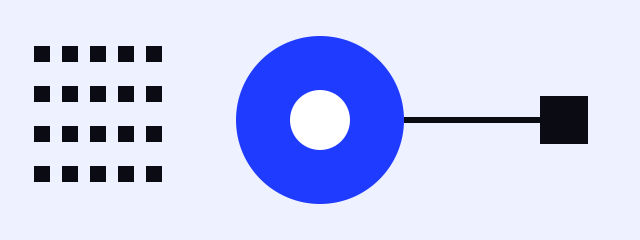
6 asks — a pile of numbers you cannot act on

1 ask — a number you can act on
What “one action” actually means
Not one link. One decision.
A page can perfectly well carry a privacy link, a contact address and a terms link without blurring anything, because nobody arrives intending to click them and nobody’s journey ends there. What breaks the measurement is a second genuine offer: a competing button, a newsletter box with equal visual weight, a menu that leads to five other things you also sell.
The practical test is to ask what you would do if the page could only report one number. If the answer is obvious, the page has one action. If you would need two, it has two, and you should consider splitting it into two pages and sending different traffic to each.
The form is part of the decision
The other place a single action quietly becomes several is the form itself, and it is worth treating as part of the same argument rather than as a separate optimisation topic.
Every field is a small decision. A name and an email address is one decision with two keystrokes attached. Eleven fields including company size, job title, budget band and how you heard about us is a questionnaire, and a visitor who abandons it halfway has converted on nothing while still counting in your denominator.
The honest framing is not “shorter forms convert better” — that is folklore again, and there are perfectly good reasons to ask for qualifying information when a lead is expensive to follow up. It is that each field you add moves the page further from producing one clean number, and that you should be able to say what each field is for. A field nobody downstream reads is pure cost.
If sales genuinely needs the budget band, ask for it. If it is there because the form builder offered it, remove it.
Where the rule stops applying
Three cases, and they are more common than the guides admit.
Considered purchases. Somebody buying enterprise software is not converting on a first visit and a page that only offers “buy now” is wasting the visit. A secondary, deliberately lower-weight action — a document, a specification, a recorded demo — is a reasonable capture rather than a distraction. Weight it clearly below the main one and expect the numbers to be messier.
Pages that also have to be found. A page that ranks organically and also receives paid traffic is not really a campaign page. It needs context, internal links and somewhere for a reader to go next, and applying campaign-page rules to it will cost you more in organic traffic than it returns in clarity.
Multi-offer audiences. If one ad group genuinely wants two different things, that is usually a signal to build two pages rather than to compromise one. Your domain allowance may have opinions about that, which is covered in publishing a landing page to your own domain.
One action is not one screen
A related confusion worth clearing up: stripping a page down is not the same as making it short.
The argument for a single action says nothing about length. A page selling something complicated may reasonably run to two thousand words, with specifications, objections answered and the same button repeated four times on the way down. That is still one action — the same action, offered again at the points where somebody might be ready for it.
What breaks the rule is not word count but competing asks. A short page with three different buttons is worse for measurement than a long page with one button repeated. The advice to keep landing pages brief is a separate claim, it is much weaker than the single-action one, and it is usually smuggled in alongside it.
Write as much as the decision needs. Ask for one thing while you do it.
The self-referential bit
This site is one column wide. There is one link in the header and one button at the foot of every page, and the navigation lives in the footer where somebody who has finished reading can find it.
That is not decoration; it is the same argument applied to itself. A site arguing that focus is worth something while running a sidebar, a pop-up and a sticky bar would be asking to be ignored. It is also a reasonable thing to demand of the products in this category — look at what a vendor’s own campaign pages do, because a landing page company that cannot resist putting six calls to action on its own homepage is telling you something.
What to take away
Strip the page because it makes the result legible, not because somebody’s case study produced a memorable percentage. Keep exactly one decision on it. Let the secondary things be genuinely secondary, visually and in your reporting.
And when you have a page you can measure, the next question is what it costs to measure two of them — which is the subject of what A/B testing costs to turn on, and the number the whole ranking is built around.
Where this sits
Every piece here exists to support one page: the best landing page builders. Start there for the short answer, come back here for the workings.
One thing to do next
See which landing page builder actually fits the traffic you have.